
Flash
Be the fastest player alive

One of the most basic ideas in any kind of turn-based game is that each player gets control of the game when it’s their turn. And Magic, like most games, usually follows this rule. With a pretty large exception we’ve previously discussed (Counterspells), that directly interact with your opponent while they’re trying to play something, most Magic cards are restricted to only being played at certain times, in certain ways. But increasingly, Wizards has deemed fit to print cards that skirt that boundary to say the least.
Flash is a keyword first introduced in Time Spiral, a wildly inventive set about reframing the past. And as such, it reinvented a player’s past turns, allowing the deployment of permanent cards at instant speed. Originally locked primarily to Blue, it’s over time shifted into something common for Azorius mages as a whole, allowing control players to leave their lands untapped for the choice of counterspells or threat deployment, depending on the board state.
A quick technical note. Flash as a keyword cares more about turns, steps, and phases of Magic than any keyword previously discussed. So it’s worth laying out the full phases of a Magic turn. As such, we’ll be using this diagram from Reddit as our guide for today:
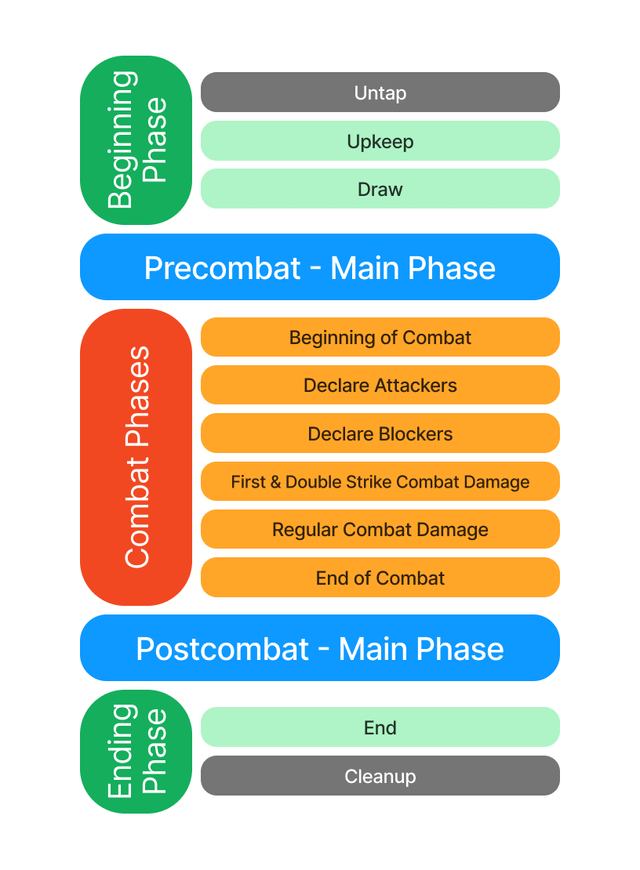
In specific, the turns go start of turn, Untap phase (permanents reset tap/untap status to untapped), Upkeep (a special sub-phase for start of turn effects that’s gradually seeing less and less usage outside special circumstances), Draw phase (where active player draws a card), Main Phase 1 (where lands and Sorcery-speed spells (most spells) can be played), Combat phases (Beginning of combat, where triggers happen; Declare Attackers; Declare Blockers; First Strike Damage; Regular Damage; End of Combat/Combat clean-up), Main Phase 2 (same rules as Main Phase 1), End Step (where the end of the turn starts), and Cleanup (where “until end of turn” effects end). Part of what’s special about Flash as a keyword is that it can be deployed in response to any trigger starting in any of these sub-phases, as well as the start of the end-phases themselves, with the exception of the Cleanup.


Among the first batch of cards granted the keyword out and out was Teferi, Mage of Zhalfir; a reinterpretation of a classic character, he both had Flash and could give Flash to your other creatures not in play, while restricting your opponent to sorcery speed. Another blue powerhouse is Kaladesh’s Torrential Gearhulk, a 6-mana 5/6 that flashes in to play an instant from the graveyard for free (and then Exile that instant). A more modern staple, M20’s Spectral Sailor is a 1-mana 1/1 Flier that Flashes in and can draw a card for 3 and a Blue. As previously stated Counterspells work well with Flash, and Spellstutter Sprite (a 2-mana 1/1 Flier that Flashes in and counters a spell on ETB unless the targeted player pays mana equal to the number of Faeries Sprite’s owner controls) is no exception. A White example of an iconic Flash card would be Whitemane Lion, a 2-mana 2/2 that bounces a creature you control (sometimes itself!) on ETB, which can be good for protection against removal spells for important creatures.
Next week, we’ll be on time with the cards we play. See you then!